
Mastering Annual Contract Value (ACV): A Comprehensive Guide for SaaS Companies

In today’s competitive SaaS landscape, understanding and effectively utilizing financial metrics is key to driving growth and maintaining a competitive edge. Among these metrics, Annual Contract Value (ACV) stands out as a vital indicator of a company’s financial health and customer relationships. For SaaS companies, mastering ACV can unlock significant insights into revenue generation, customer segmentation, and strategic planning.
This comprehensive guide aims to demystify ACV, providing SaaS professionals with the knowledge and tools needed to calculate, analyze, and leverage this crucial metric. From defining ACV and clearing up common misconceptions, to exploring its comparative role alongside other metrics like ARR, TCV, and LTV, you’ll gain a robust understanding of where ACV fits into your business strategy. Dive in as we explore step-by-step calculation methods, strategic uses of ACV in pricing and marketing decisions, and innovative strategies to increase your ACV and secure sustained growth.
Understanding Annual Contract Value (ACV)
Definition and Importance
Annual Contract Value (ACV) is a critical metric for Software as a Service (SaaS) companies, representing the average revenue generated per customer contract over a year. Essentially, ACV provides insight into the company’s revenue flow from its subscription-based clients, helping to determine the organization’s financial health. By focusing on ACV, companies can assess the profitability of their customer relationships and make strategic decisions to enhance their revenue streams.
Common Misconceptions About ACV
There are several common misconceptions about ACV that can lead to misunderstandings when analyzing a company’s performance. One major misconception is equating ACV with other financial metrics like ARR (Annual Recurring Revenue) or TCV (Total Contract Value). It’s crucial to note that ACV specifically focuses on annualized values, making it distinct from metrics that consider different timeframes or encompass one-time fees.
ACV vs. Other Metrics: ARR, TCV, and LTV Comparisons
To fully grasp the significance of ACV, it is imperative to compare it with related financial metrics such as ARR, TCV, and LTV (Customer Lifetime Value). While ARR accounts for the yearly recurring revenue from subscriptions, TCV considers the total revenue anticipated from a customer contract over its entire lifecycle. Meanwhile, LTV measures the total revenue a business can expect from a customer across the duration of their relationship. These metrics collectively offer a comprehensive understanding of customer value and revenue projections.
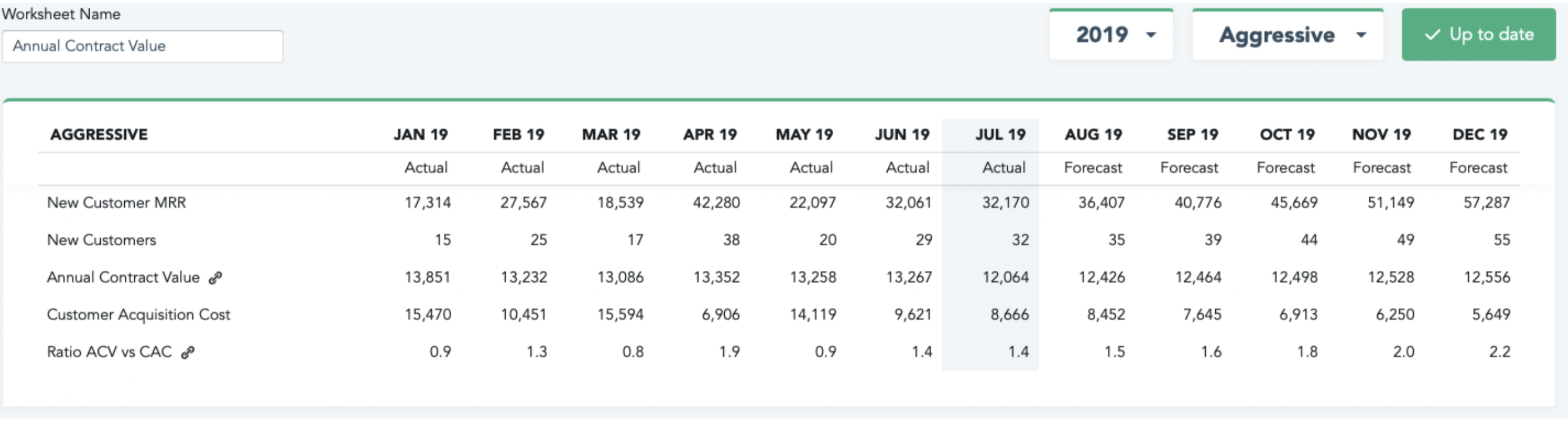
Each metric plays a unique role, and together they form a comprehensive picture of a company’s financial landscape. Understanding how ACV interacts with these other metrics is crucial for more accurate financial forecasting and strategic decision-making.
With a clear understanding of what ACV encapsulates and how it contrasts with similar metrics, the next step is to delve into the intricacies of accurately calculating ACV.
Calculating ACV: A Step-by-Step Approach
The ACV Formula
The Annual Contract Value (ACV) is a critical metric for SaaS companies aiming to understand their revenue flow on an annual basis. Calculating ACV allows a business to assess the average annual monetary value derived per customer contract and plays a vital role in business strategy and forecasting. Here’s the formula used for calculating ACV:

ACV can be calculated by taking the total contract value and dividing it by the number of years in the contract. If all contracts are annual, it’s equivalent to the contract value itself. This simple yet powerful formula gives insights into the profitability and long-term sustainability of a company’s offerings.
Calculation Examples for Different Contract Scenarios
Let’s delve into practical examples that illustrate how ACV can vary across different contract structures:
1. **Single-Year Contract Example**: Suppose your SaaS product is priced at $12,000 per year. If a customer commits to a one-year contract, the ACV for that customer is simply $12,000.
2. **Multi-Year Contract Example**: Consider a scenario where a customer chooses a two-year contract valued at $20,000. Here, the ACV is determined by dividing the total contract value by the number of years, resulting in an ACV of $10,000 per year.
3. **Custom Pricing Example**: In cases of discounts or variable pricing, such as a three-year contract with a first-year payment of $10,000 and $15,000 for the subsequent years, the total would be $40,000. Therefore, the ACV is $40,000 divided by three years, resulting in an ACV of approximately $13,333 per year.
Tools and Resources for Accurate ACV Calculation
Accurate calculation of ACV is essential for making informed business decisions. There are various tools and resources which can aid in simplifying and streamlining ACV calculations:
– Accounting and CRM software like QuickBooks or Salesforce often offer built-in features for tracking revenue metrics, including ACV.
– Financial modeling spreadsheets can be custom-built to include formulas that automatically calculate ACV based on inputted data, offering flexibility and control.
– Several online calculators and SaaS-specific analytics platforms provide dedicated modules for calculating and interpreting ACV efficiently.
Mastering the calculation of ACV arms your business with quantitative insights into the value each customer relationship brings over time. Use these insights to tailor strategies that better leverage your revenue streams. As you grow more confident in calculating ACV, the next step is leveraging these insights for strategic business decisions that pave the way for enhanced growth and profitability.
Leveraging ACV for Strategic Business Decisions
Optimizing Pricing Strategy Using ACV
Annual Contract Value is crucial for shaping your pricing strategies. By analyzing ACV, SaaS companies can identify which contract terms are most effective in maximizing revenue. Understanding the nuances in ACV allows businesses to adjust pricing models and create tiered pricing structures that align with customer value and willingness to pay.
ACV as a Metric for Customer Segmentation
ACV serves as a powerful tool for segmenting your customer base. By categorizing customers based on their contract value, companies can tailor marketing and sales efforts to diverse segments. This approach ensures that high-value clients receive more personalized attention, potentially increasing customer satisfaction and retention. Moreover, it helps companies to allocate resources effectively and target new potential clients with similar profiles.
Incorporating ACV in Sales and Marketing Decisions
Sales and marketing strategies benefit greatly from insights derived from ACV data. By understanding which customer segments yield the highest ACV, businesses can tailor their sales pitches and marketing campaigns to attract similar clients. This strategic application not only drives revenue growth but also optimizes customer acquisition costs.
Having explored how ACV can be leveraged for strategic business decisions, it’s vital to focus on methods to increase your ACV. Let’s delve into strategies and techniques that can effectively elevate your company’s ACV, enhancing overall business performance.
Strategies to Increase Your ACV
Upselling and Cross-Selling Techniques
One of the most effective strategies to boost your ACV is through upselling and cross-selling. Upselling involves offering customers a higher tier of your product or service with additional features and benefits. On the other hand, cross-selling suggests complementary products or services that enhance the customer’s primary purchase. By identifying customer needs and crafting personalized offers, companies can increase the contract value while simultaneously improving customer satisfaction.
Enhancing Product Offerings
Continuous innovation and enhancement of your product offerings can significantly influence your ACV. By adding new functionalities, better performance, or even integrating popular third-party services, you can provide more value to your customers. Ensuring that these enhancements directly address customer pain points will not only justify a higher price but will also build long-term loyalty and trust.
Tailoring Contracts for Larger Clients
Customizing contracts to suit larger clients is another important strategy. Large enterprises often have specific requirements that can’t be met with a one-size-fits-all approach. By offering bespoke solutions, volume discounts, or extended payment terms, you can attract and retain large customers. Moreover, these tailored contracts should focus on showcasing how your solutions address their unique challenges, thereby increasing their perceived value and ACV.
With these strategies in place, your path towards maximizing ACV becomes clearer, aiding in the sustainable growth of your business. Next, let’s explore how to maintain and analyze ACV for continued success, ensuring your strategies evolve alongside your business needs.
Maintaining and Analyzing ACV for Sustained Growth
Customer Retention Strategies
Customer retention is pivotal in maintaining a stable ACV. By fostering strong relationships with customers through personalized communication and feedback loops, companies can enhance loyalty and minimize churn. Implementing a robust customer support system and providing continuous value to the user can significantly impact retention rates, thus sustaining or even increasing ACV. Understanding Churn Rate is crucial in this context.
Data-Driven ACV Benchmarking

Analyzing ACV through benchmarking against industry standards and competitors helps identify areas of improvement. Utilize data analytics to assess where your business stands and what strategic adjustments are necessary. Understanding how your ACV fares in the market enables the identification of weaknesses and opportunities to refine business operations and marketing strategies.
Regular Review and Adjustment of Pricing Strategies
An effective pricing strategy is key for ACV growth. Regularly reviewing pricing models to align with customer value perception and market trends enhances competitiveness and profitability. Adjust pricing based on comprehensive analysis and trend observations to maintain a balanced growth trajectory, ensuring ACV is optimized and sustainable over time.
Seamlessly integrating these strategies into your business model ensures a proactive approach to nurturing and analyzing ACV. It sets the foundation for not just sustaining ACV but also for scalable growth as we explore further tactics and advanced strategies to enhance your business performance.