
How to Calculate the Rule of 40


Understanding the Rule of 40
What does the Rule of 40 measure?
The Rule of 40 is a simple benchmark used to evaluate the balance between growth and profitability in a SaaS or subscription-based business. It’s calculated by adding a company’s revenue growth percentage to its profit margin percentage. If the sum is 40% or higher, a company is often considered to be in good financial health, striking a favorable tradeoff between expanding and sustaining itself.
Why is it important for SaaS and growth-stage companies?
High-growth SaaS companies often face a decision: invest for growth at the cost of profit, or slow expansion to retain higher profitability. The Rule of 40 provides a quick pulse check—are you sacrificing too much profit chasing growth, or vice versa? Investors and founders use this metric to cut through varying financial results and spot sustainable business models that can weather market shifts.
Now that you understand the purpose and significance of the Rule of 40, let’s break down the actual formula and see which numbers go into the calculation.
The Rule of 40 Formula and Inputs
How to calculate revenue growth rate
The first building block is the revenue growth rate. Take your company’s recurring revenue from the current period and last period. Subtract last period’s revenue from the current period’s, then divide by last period’s revenue. Multiply by 100 to get a percentage. For SaaS companies, use annual recurring revenue (ARR) or monthly recurring revenue (MRR), annualized.

This flowchart highlights how both recurring revenue and new deals, upgrades, or churn all factor into your growth input, which is the core for calculating revenue growth rate.
Which profit margin should you use? (EBITDA, operating, or net margin)
The Rule of 40 pairs revenue growth with a profit margin. The most common option is EBITDA margin—earnings before interest, taxes, depreciation, and amortization. Some companies prefer operating margin for a more direct read on business profitability, or net margin for an all-in view. Whichever you choose, consistency matters when comparing over time or against benchmarks.

This diagram shows how margin inputs flow into EBITDA percentage—highlighting why EBITDA is so widely used in Rule of 40 calculations, though other margins can tell different stories depending on your company’s stage and accounting choices.
Putting it together: The Rule of 40 formula
Once you have your revenue growth rate and profit margin, simply add them together. The formula is:
Rule of 40 Score = Revenue Growth Rate (%) + Profit Margin (%)
If the sum reaches or exceeds 40, your company is generally balancing growth and profitability in a way that signals healthy performance, at least by SaaS industry standards.

This visual breaks down the core formula: growth percentage plus profit margin equals your Rule of 40 score—a straightforward calculation with powerful implications.
With the formula and inputs in hand, let’s walk through a clear example so you can see the Rule of 40 in action, and unlock what your score really means.
Worked Example: Calculating the Rule of 40 Step-by-Step
Sample calculation with clear numbers
Let’s look at a real example so you can see exactly how the Rule of 40 comes together. Suppose a SaaS company reports annual revenue growth of 28%, and its EBITDA margin for the same year is 15%. These are the two numbers you need: growth rate, and profit margin.
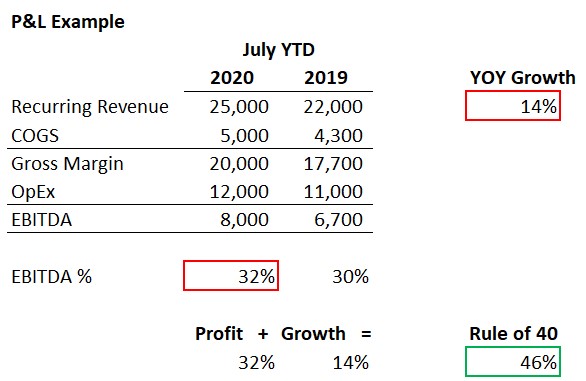
The Rule of 40 calculation is simple: add the growth rate (28%) to the EBITDA margin (15%), which gets you a Rule of 40 score of 43%.
What does your score mean?
In this example, a score of 43% is above the Rule of 40 target, suggesting solid performance. Hitting or surpassing 40% usually signals that the company is managing a healthy balance between growing revenue and turning a profit. Dropping below 40% means the company may be growing too slowly for its level of profitability, or spending too much to grow and not making enough profit to offset that spend.
To interpret your own score, remember that context matters. What drives a good Rule of 40 score in one company might not in another, depending on growth stage, industry trends, or business model. Next, we’ll look at how and when you should actually put this calculation to work in your own company, and how to think about the trade-offs involved.
Thank you for reading EasyVC’s blog!
Are you looking for investors for your startup?
Try EasyVC for free and automate your investor outreach through portfolio founders!
Thinking about your own company’s numbers now? Grab a notepad, dust off last quarter’s financials, and try running the Rule of 40 yourself. The tool is simple—but the story it tells about your growth and profitability might just surprise you.
With the calculation fresh in your mind, let’s look at how to actually use this metric to guide your company’s decisions, and when it might yield the most meaningful insights.
When and How to Use the Rule of 40
Best times to apply the Rule of 40
The Rule of 40 isn’t relevant for every company at every stage. It makes the most sense for SaaS businesses that have outgrown the earliest startup phase and are now chasing scale—think companies with steady recurring revenue and a few annual reports under their belt. At this point, consistent metrics make it possible to track both growth and profit margin meaningfully.
Applying the Rule of 40 too soon usually delivers noisy signals. Young startups might see wild swings in growth and profit that obscure any true patterns. Meanwhile, large established firms with slower growth may miss the point if they still rely on the same solo metric. Aim to use the Rule of 40 when your company has moved beyond survival mode and is focusing on the balance between accelerating growth and turning a profit.
Understanding trade-offs between growth and profitability
The Rule of 40 offers a simple score, but what it really highlights is the balancing act between pouring fuel on the growth fire and making sure dollars actually land in the bank. Few companies can max out both, so leaders are forced to choose where to press harder: rapid expansion that might shrink profitability, or tightening costs with slower growth.
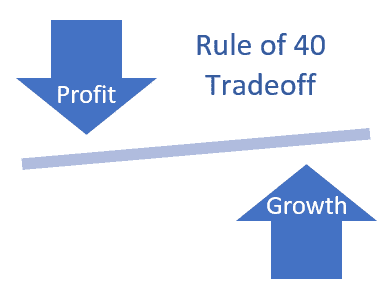
This balance depends on more than just spreadsheets. Moving into a new market might justify a temporary dip in profit margin if it accelerates top-line growth. On the flip side, if growth is slowing naturally, it’s often smarter to squeeze more from operating profits. The Rule of 40 flags when the math gets lopsided, signaling if your strategy is weighted too far in one direction.
Now that you know when to use the Rule of 40 and how growth and profitability play off each other, it’s essential to look at some of the nuances and pitfalls. Next, we’ll dig into variations of the formula and mistakes to avoid, so you can apply the metric with real confidence.
Variants and Limitations
Weighted Rule of 40: Do all inputs matter equally?
The original Rule of 40 treats revenue growth and profit margin as equally important, simply adding the two together. But in reality, some companies—and their investors—see these factors differently. For example, a software business with established cash flow may favor strong profit margins, while an earlier stage company is rewarded for aggressive growth. The weighted Rule of 40 variant reflects this by assigning more importance to either growth or profit, such as 60% weight on growth and 40% on margin, or vice versa. The weighting system helps tailor the Rule of 40 to a business’s stage or strategy, but it can also make comparisons between companies less straightforward.
Common mistakes to avoid in Rule of 40 calculations
It’s easy to make errors when calculating your Rule of 40. First, always check the time periods for your inputs: mixing quarterly growth with annual margins will skew your number. Second, be consistent about the profit metric you use—don’t switch between EBITDA, operating margin, or net margin without a clear reason. Finally, using non-GAAP adjustments or one-off gains can inflate your results and give a misleading sense of the company’s health. When in doubt, stick to simple, audited numbers, and make sure you’re comparing apples to apples.
Understanding the nuances of the Rule of 40 will help you interpret your results more accurately—and know when it’s time to look beyond a single formula. Next, let’s dive into how peer companies stack up and see how investors actually use this metric in real-world evaluations.
Benchmarks and Real-World Context
Typical Rule of 40 scores by company stage
What counts as a “good” Rule of 40 score shifts with company maturity. Early-stage SaaS startups often emphasize breakneck growth, and as a result, their profit margins lag or may even be negative. Mature companies are expected to achieve a healthier balance, with slower growth but stronger margins.
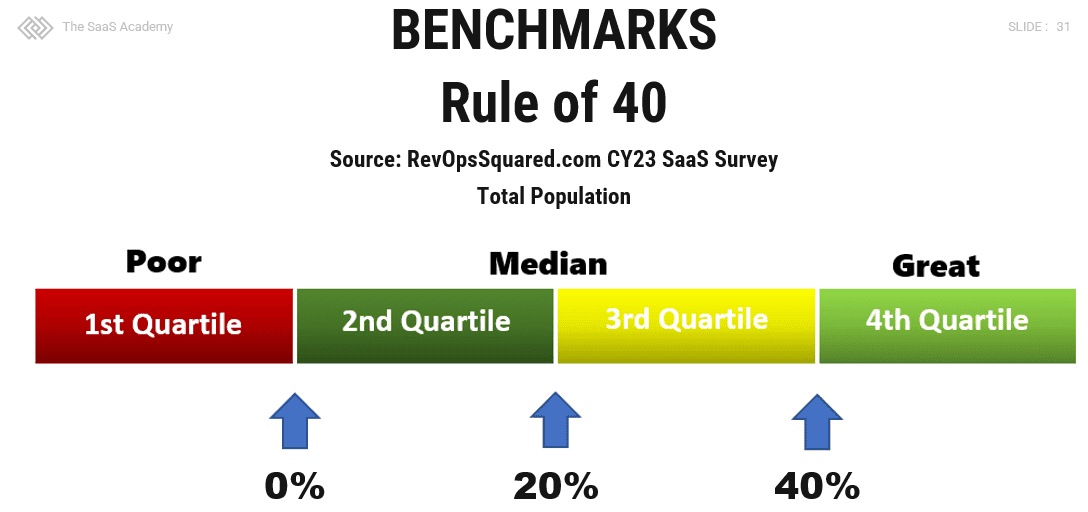
Quartile data from industry benchmarks shows most public SaaS firms hover between 20 and 50 on the Rule of 40 scale. Consistently reaching or exceeding 40 is rare for startups, but as firms approach IPO, their scores tend to consolidate in the 35–45 range. Scores above 40 signal operational efficiency—companies can balance investing for future growth while retaining healthy profit margins.
How investors use the Rule of 40 in evaluation
The Rule of 40 acts as a quick check for investors to gauge whether a SaaS company is scaling sustainably. Rather than demanding staggering growth and profitability at once, the Rule of 40 rewards firms that can blend these forces based on their stage. For venture capital and private equity professionals, a Rule of 40 score below 30 may indicate unsustainable spending or growth without discipline. Meanwhile, consistently topping 40 turns heads, signaling the company is either a mature cash producer or an unusually disciplined grower.
Understanding these benchmarks and investor expectations sets the stage for making practical use of the Rule of 40 when reviewing your own performance or conducting a peer comparison.
Summary: Getting Value from the Rule of 40
The Rule of 40 distills two important signals—growth and profitability—into a single number. By looking at this sum, teams and founders can see whether their business is delivering sustainable performance or if there’s a gap between momentum and financial discipline. A score above 40 suggests a healthy balance; below 40 means something is out of sync and may require attention.
But the value of the Rule of 40 goes beyond the calculation itself. It sharpens focus, prompting better questions: Are you chasing revenue at the expense of margins? Is profitability coming at the cost of innovation and growth? It also allows you to track progress as your strategy evolves, revealing trade-offs and ensuring your growth story remains grounded in operational reality.
As a tool, the Rule of 40 isn’t a pass/fail grade. It’s a lens—offering quick perspective in boardrooms, investor decks, or quarterly reviews. Used regularly, it can guide decision-making and help teams quickly identify when to double down, pivot, or rebalance priorities.
Next, let’s look at when it makes the most sense to use the Rule of 40 and how to apply it in practical situations, so you know where it fits in your planning toolkit.