
How to Calculate Runway

Knowing how long your business can keep running with its current cash—before you need new funding or to make a change—is crucial for every founder or manager. This timeframe is called your runway. If you’ve ever wondered, “How many months do I have before I run out of money?” you’re not alone. In fact, a 2022 CB Insights report found that 38% of startups fail because they run out of cash. That’s why understanding how to calculate your runway isn’t just useful—it’s essential for survival.
In this article, we’ll break down what runway really means, how to calculate it step-by-step, and why it matters no matter what stage your business is at. Even if math isn’t your thing, you’ll find simple ways to figure out your numbers—and some practical tips for making your runway last longer.
What Does Runway Mean?
When people talk about a company’s “runway,” they’re referring to the number of months the business can keep running at its current spending level before running out of cash. It’s a measure of time, not distance—a countdown clock tracking how long your cash can last without more revenue or funding appearing.
Runway vs. Burn Rate
Burn rate tells you how much money you’re spending each month above what you bring in. Runway takes that number and flips it—using your burn rate to figure out how many months your existing cash will stretch. In short: burn rate is speed, runway is distance, both measured by your remaining cash and your monthly spending.
When Does Runway Matter Most?
Runway is especially important for startups and growing businesses that aren’t yet profitable, or when revenue is bumpy. If you’re seeking funding, managing a product pivot, or facing unpredictable expenses, runway becomes your early warning signal: it shows how much cushion you have before tough decisions are required.
Next, let’s look at the core numbers you need to know before you can actually figure out your runway—and how to avoid the common pitfalls that trip up founders and finance teams alike.
What You Need Before Calculating Runway
Cash on Hand: What Counts and What Doesn’t
You’ll want to start with your current cash balance—but be careful about what you include. Only count cash and equivalents you can actually access: the money in your bank accounts or instruments you can quickly turn into cash. Don’t include undrawn lines of credit, expected funding rounds, or money tied up in inventory.
Exclude receivables unless you’re absolutely sure they’ll hit your account soon. Likewise, don’t count funds earmarked for taxes or other committed expenses. Think of this tally as your true “available fuel.”
Finding Your Monthly Burn Rate
Now zero in on how much money you’re spending each month to keep the lights on. Pull your recent monthly bank statements and focus on all outgoing cash—payroll, rent, marketing, subscriptions, and overhead.
You’ll need an average, not just a single month’s data. Fluctuations are common, so look at your last three to six months and calculate the average monthly outflow. That smooths out any spikes caused by one-off expenses.

Gross vs. Net Burn
Burn rate often gets split into gross and net. Gross burn is the total money leaving your accounts each month—no revenue considered. Net burn subtracts any recurring monthly income from that total, showing the true decline in your cash reserves.
If, for example, your company spends $80,000 per month (gross), but brings in $20,000 in revenue, then your net burn rate is $60,000. For most runway calculations, net burn gives you the clearest picture of how long your cash will last.

Once you’ve pinned down your true cash position and average net burn rate, you’re ready to put the runway formula to work. Let’s see exactly how that calculation comes together, step-by-step.
Runway Formula and Step-by-Step Calculation
The Classic Calculation Formula
Calculating runway is simple if you have your current cash balance and a clear burn rate. The traditional formula is:

Runway (months) = Total Current Cash / Monthly Net Burn Rate
Suppose your company has $120,000 in the bank and loses $20,000 monthly. Plug the numbers in: $120,000 ÷ $20,000 = 6 months of runway. This figure tells you how long you can operate before funds run dry, assuming nothing else changes.
Adapting for Revenue Fluctuations
Sometimes, monthly revenue isn’t consistent. If sales spike or dip, a static formula could mislead you. For a startup with irregular income or variable expenses, adjust your calculation. Instead of a single month’s burn rate, use the average of the past few months, or forecast net cash using your best estimates for upcoming changes.
For example, if you expect a big client payment next month, you could include that expected revenue in your cash flow projections. Just mind the risk of relying on predictions. Be conservative: plan for the expenses you know will happen, and only build in revenue you’re confident about.
3-Month Rolling Average as a Smoother
To account for bumps in spending or unpredictable revenue, many founders use a 3-month rolling average for burn rate. Add up your net burn for the last three months, divide by three, and use this average in your calculation. This evens out unusual spikes or drops and gives a truer picture of typical spend.
As you master runway calculations, you might wonder if there’s a faster or more automated way to crunch these numbers—or check different scenarios without the manual effort. That’s where the next section comes in.
Runway Calculator: Quick Tools and How to Use Them
Manual Calculation Example
Calculating runway doesn’t require fancy software. You can build a basic calculator in any spreadsheet program using just your cash balance and burn rate. Here’s how it works: add up your business’s ending cash every month, take your average net burn for recent months, then divide cash by burn rate to find your runway in months.
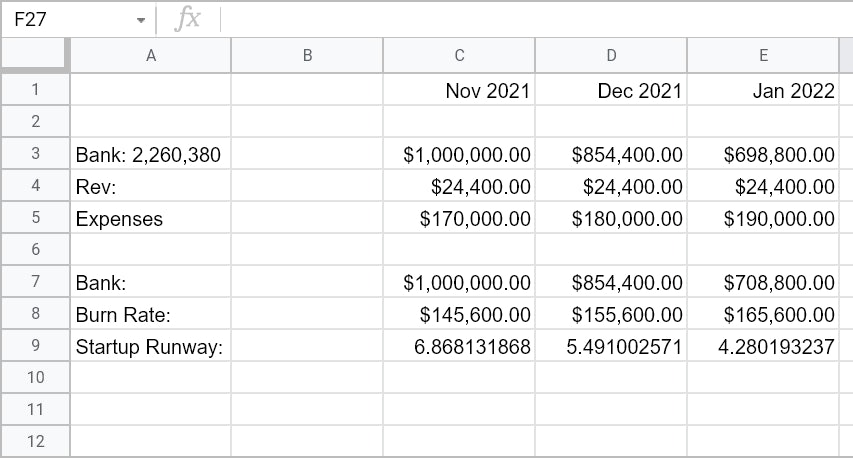
The spreadsheet above tracks revenue, expenses, bank balances, and calculates monthly burn rate along with runway. With just three months of data, you can spot trends and make quick runway estimates. It’s simple, fast, and perfect for small teams or founders who prefer hands-on numbers.
Digital Tools and Spreadsheets
If you want more power or just less number crunching, digital calculators and pre-built spreadsheet templates do the heavy lifting. Online tools let you plug in beginning balance, planned expenses, upcoming revenue, and even simulate new funding rounds or growth scenarios. They instantly recalculate how many months you’ve got left, and many offer colorful charts that update as you tweak assumptions.

Spreadsheets from sites like Pry, Fuel, or Google Sheets templates can model everything from seasonality to staged growth, and instantly visualize the impact of big decisions. Just make sure you update them regularly with fresh numbers to keep your runway insight sharp.
Whether you prefer a spreadsheet or a slick online dashboard, using these tools removes guesswork and lets you stay ahead of tough financial decisions. Next, let’s explore how to decide if your runway is actually long enough for your goals and upcoming milestones.
Thank you for reading EasyVC’s blog!
Are you looking for investors for your startup?
Try EasyVC for free and automate your investor outreach through portfolio founders!
Feeling uncertain about how long your startup can keep its lights on? Don’t guess—run the numbers with confidence. Accurate runway calculation separates survivors from stories. It’s the lever you control, not just a dashboard stat.
If you want to stay ahead, grab your latest balance sheet and expenses. In the next section, let’s look at how much runway is “enough”—and how that answer depends entirely on your stage, ambitions, and what’s around the corner.
How Many Months Is Enough Runway?
Benchmarks for Different Stage Companies
The “right” amount of runway feels different depending on your stage and the stability of your company’s cash flow. Early-stage startups fresh off a funding round often target 18-24 months of runway. This buffer leaves room for growth experiments, inevitable missteps, and the slow process of preparing the next raise.
As companies mature, 12 months of runway may feel more comfortable, assuming revenue is picking up or on track to do so soon. Businesses with recurring revenue or predictable customer contracts might operate safely with even less — but that’s not an excuse to grow complacent. Market shifts, delayed deals, or ambitious headcount plans will burn through that slack quickly.
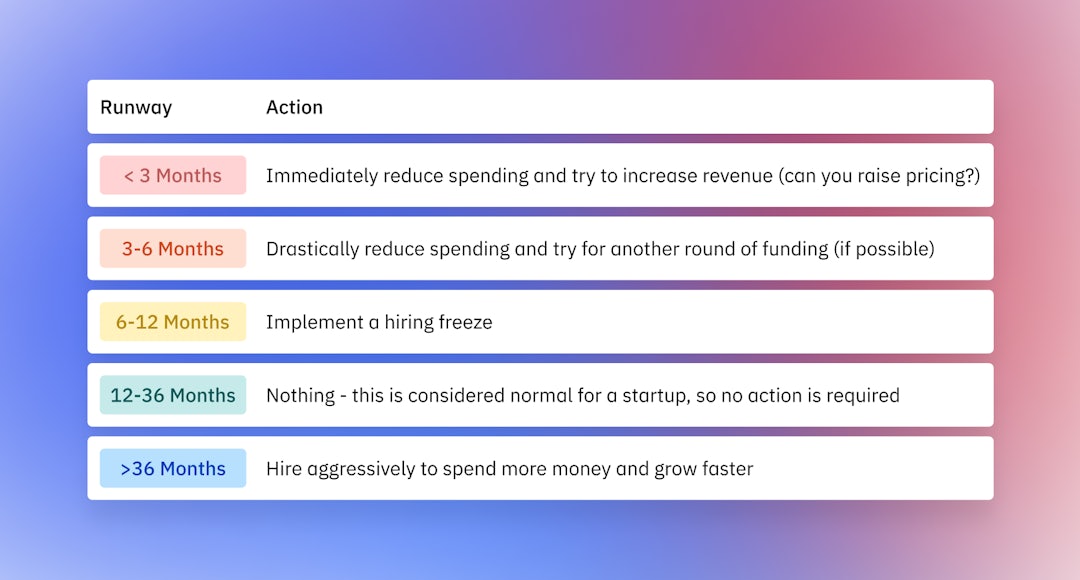
The image above offers a visual framework: less than six months and it’s time for decisive action; 12 months is a safe middle ground; anything beyond 18 months brings calm but can also tempt unnecessary spending. Striking the right balance means matching your planned milestones, product launches, and growth goals against your cash calendar, rather than aiming for a magic number alone.
Runway and Fundraising Timing
It’s easy to think that as long as you have runway, you’re covered. But things get tricky when you factor in how long it takes to raise money. Most investors want to see at least six months of cash left when you knock on the door; three months is often considered too late. That means if you plan to raise, you really need to start the process around the time you hit nine months of runway—sometimes earlier if the market is tough or your growth isn’t on autopilot.
Founders sometimes gamble by waiting longer, hoping for standout results before raising. But that narrow window leaves little room for negotiation and even less for things not going to plan. Being realistic—and cautious—about the time needed to close new funding will keep you ahead of the curve.
Understanding how benchmarks and timing work together is only one side of the coin. If runway is looking thin or your revenue curve is flatter than you’d like, the next step is figuring out how to buy yourself more time before the clock runs out.
How to Extend Your Runway
Reduce Expenses Without Harming Growth
Trimming costs doesn’t always mean painful cuts. Start by analyzing your monthly spending in detail. Look for recurring payments to tools or subscriptions you rarely use. Renegotiate with vendors or providers for better rates, especially if you’re a reliable customer. Pause or postpone projects that don’t impact sales or product momentum. If you have a team, encourage suggestions for small but meaningful savings—those add up over time. Avoid cutting areas that directly drive users, revenue, or product improvement.
Boost Revenue Quickly
A quick jolt in income can make a big difference to your runway. Consider running limited-time offers or discounts to incentivize new sign-ups or upsells. Can you invoice faster, or offer incentives for early payment? If you have loyal customers, test new services, add-ons, or packages that address their immediate needs. Investigate partnerships that open up new distribution or customer channels on short notice. These initiatives don’t require months of planning but can move the needle fast.
Raising Capital or Finding Bridge Funding
If trimming costs and boosting sales isn’t enough, external capital might be necessary. Start with your existing investors—they understand your business and can act quickly for bridge rounds. Explore short-term loans, revenue-based financing, or government-backed programs if interest rates are reasonable and repayment timelines fit your projections. Be transparent with potential backers about how new funding will extend runway and lead you to clear, tangible milestones.
Extending your runway often calls for a mix of these tactics—small wins add up, and decisive steps can buy crucial extra months. Now, let’s look at the benchmarks that can help you decide whether your new runway length is actually enough.
FAQ: Runway Calculation in Practice
How Often Should You Recalculate Runway?
Update your runway calculation at least once a month. If your company is burning cash quickly, navigating uncertain markets, or in active fundraising, check it every two weeks or even weekly. Big events—like team changes, large contracts, or investments—are also signals to update the numbers.
Is Positive Runway Always a Good Sign?
Not necessarily. A “positive runway” just means you have some time left given your current spending pace. It doesn’t speak to how much time or what condition your business is in. If your runway is stretched because you slashed costs and paused growth, the topline number may hide brewing problems.
Difference Between Projected and Actual Runway
Projected runway uses budgets and forecasts for future income or spending. Actual runway relies on past, real cash movements—what’s shown on your statements. If your monthly spending or income is unpredictable, projected runway can swing wildly from actual results. Always check both and be ready to react if reality drifts from your plan.
Now that you’re clear on common runway calculation questions, it’s time to consider how much runway is enough for your stage and goals—so you can turn your insights into decisions.