
Formulas for Startup Valuation: Methods, Examples and Key Factors

How much is your startup really worth? It’s a question that stirs debate in almost every pitch meeting and fundraising round. Getting the right answer is crucial—recent studies show that over 90% of startups face difficulty attracting investment, and unrealistic valuations are a common cause of missed opportunities for both founders and investors.
But valuing a startup isn’t as simple as plugging numbers into a spreadsheet. Most young companies don’t have steady revenues or long financial histories. Instead, their value is often built on potential: their team, idea, traction, technology, and even the market they hope to disrupt.
This introduction will help you cut through the confusion. We’ll break down the common formulas and methods used to value startups, explore the key factors that matter most, and walk through real-world examples so you can see these theories in action. Whether you’re planning your first raise or just curious about how investors see your business, understanding these basics is a practical step toward navigating the world of startup valuation.
What Is Startup Valuation?
What Is Startup Valuation?

Startup valuation is the process of assessing what a young company is worth in financial terms—even before it’s turning a profit or has much of a track record. Unlike established companies where revenue and earnings drive calculations, valuation for startups centers on future potential rather than current results.
It’s not just about putting a price tag on a new idea. Valuation captures expectations for growth, factoring in how disruptive a company might be, the size of a problem it’s trying to solve, and whether the team behind it can make things happen. For founders and investors alike, knowing this number is essential: it sets the terms for fundraising deals, influences equity splits, and provides a critical benchmark when making strategic decisions down the road.
In early-stage ventures, where past financials are thin or non-existent, the valuation process leans heavily on outside indicators: comparable company performance, market trends, and the credibility of founders. In essence, startup valuation is less about spreadsheets with decades of data, and more about narrative, potential, and risk.
Understanding what drives this number is just the beginning. Next, we’ll dive into the specific qualities and metrics that shape how a young company’s value is determined.
Factors That Influence Startup Valuation

Every startup wears a different set of advantages and risks, and no two valuation stories are alike. Five factors usually shape how investors and founders think about a startup’s worth, even before any formulas hit the table.
Traction and Growth Potential
Investors want tangible signs that customers crave what the company is building. Real users, paying clients, accelerating metrics, and vital partnerships signal that the flywheel has started turning. The bigger and faster this momentum grows, the more it multiplies perceived value—early signs of market fit can unlock premiums, even without hefty revenues yet.
Market Size and Competition
A startup’s upside is tethered directly to its sandbox. Investors size up total addressable markets: Is it a sliver or an ocean? Expansive markets with sluggish incumbents are seen as goldmines. Too-crowded markets with little whitespace tend to compress what someone’s willing to pay.
Founder and Team Strength
Execution trumps ideas. A founder with grit, domain expertise, and a bag of startup scars can help tilt the scales in valuation. Deep networks, technical prowess, and a core team with complementary skills amplify trust, especially if they’ve pulled off wins together in the past.
Intellectual Property and Technology
Defensible assets—patents, proprietary tech, or unique algorithms—create moats that deter copycats. Original technology can mean premium pricing power and competitive insulation, especially in markets where innovation outpaces regulation. Without a moat, a startup’s value can get flattened quickly.
Revenue, Burn Rate and Runway
Recurring revenue is rocket fuel for higher valuations, even at modest levels. Just as critical: the burn rate and cash runway. Strong financial discipline shows founders can stretch a dollar and avoid premature pressure to raise at unattractive terms. Predictable, efficient growth often outweighs explosive, unsustainable scaling.
Understanding the forces behind a startup’s value creates a practical lens for applying valuation methods. Next, let’s break down popular formulas and see how these factors show up in the numbers.
Common Formulas for Startup Valuation

No two startups look alike on paper, so investors and founders turn to a range of valuation formulas designed for companies with limited operating history. Each method weighs different factors—from market comparisons to future projections—to build a picture of what a new company might be worth. Here’s a closer look at the most widely used formulas:
Berkus Method
The Berkus Method is a quick, back-of-the-napkin way to value early-stage startups. It assigns up to $500,000 (or similar milestone values) for different risk-reducing elements, including a working prototype, quality management team, strategic relationships, product rollout or sales, and sound idea. Totals typically cap at $2 to $2.5 million for pre-revenue startups.
Scorecard Valuation
This approach compares your startup to others that have recently secured funding in your region and sector. It starts with an average local deal valuation, then adjusts that number up or down according to criteria like the strength of your team, idea, market size, product stage, and competition.
Risk Factor Summation
Risk Factor Summation involves tallying up key business risks—like regulatory hurdles, technology, competition, or funding climate—and assigning positive or negative dollar values to each. The total modifies a baseline valuation, resulting in a number that goes up or down depending on the perceived risks.
Cost-to-Duplicate
With this formula, you estimate how much it would cost to rebuild your startup from scratch—including code, product prototypes, intellectual property, and early traction. While straightforward, it doesn’t account for intangible assets like brand or growth potential, so it’s usually a starting point, not the final word.
Comparable Transactions
This method searches for similar startups that have recently been acquired or funded and uses their valuations as a reference point. Factors like company stage, sector, team, and market conditions help adjust those benchmarks so you’re not comparing apples to oranges.
Discounted Cash Flow (DCF)
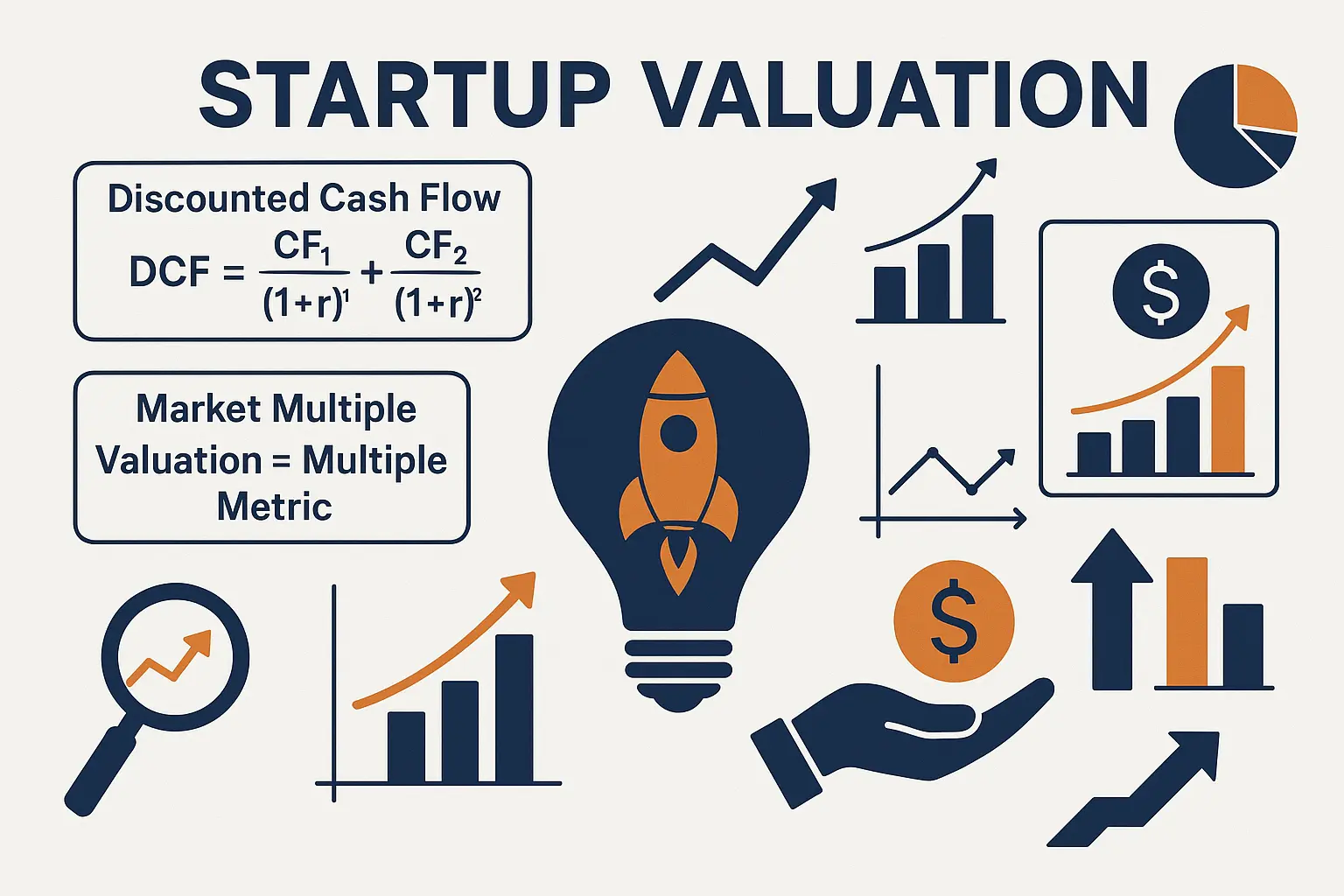
DCF projects the startup’s future cash flows and discounts them to today’s value, using a high discount rate to reflect risk and uncertainty. The formula is: Valuation = Σ (Future Cash Flow / (1 + discount rate) ^ year). DCF demands realistic long-term forecasts, which can be tricky if a startup is pre-revenue or highly volatile.
Venture Capital Method
A favorite for venture firms, this formula starts with the size of a hoped-for exit (like an acquisition at year 5), subtracts projected dilution, and works backward using an expected return rate. It’s commonly used for startups eyeing rapid scale and liquidity events. For more details, see the art of venture capital fundraising deck.
Book Value Method
Book value is straightforward: tally all tangible assets and subtract liabilities, as listed on the balance sheet. With startups, this usually undervalues the company, since future prospects—and intangible assets like technology or customer pipeline—are ignored. Still, it offers a baseline, especially for hardware or capital-intensive startups.
Each method brings its own strengths and blindspots. The true value of a startup often lies at the intersection of these approaches—where market realities, potential, and risk all meet. Once you know the formulas, the next step is understanding how to apply them with real examples and context.