
A real guide on B2C retention & churn


Understanding retention in B2C
Are you a founder creating a B2C product or are you an investor analyzing a B2C company? Do you spend hours searching for terms like “churn”, “retention” or “Life Time Value” only to find that most retention-related posts available online talk about closing ratios or 2% monthly churn, all the while half of your paying users fall month after month from your platform? You may have asked yourself, what is going on and what am I missing?
In the midst of the craziness, and in the absence of useful information on B2C SaaS models, we want to dedicate this post to talk about the important and little-known aspects of B2C. This post will help you understand the correct approach to measure progress.
The main objective of any SaaS model is to find a balance between CAC and retention, so that the cost of acquiring a long-term committed user is less than the revenue generated by the user during that commitment period. Each company can achieve this goal by obtaining different metrics at different steps in the conversion funnel. This is why applying a mental checklist with ready-made numbers of what a SaaS model should have is not the best way to predict the success of the model.
Difference between B2B and B2C
How SaaS companies find this balance depends on whether they are a B2C or B2B model, since each one presents a number of crucial differences.
- B2B: The average cost of acquiring a long-term customer in B2B is in the hundreds of dollars, so in order to keep the balance in B2B when the CAC is high, higher prices and lower churn are required.
- B2C: The average cost of acquiring a long-term customer is only in the tens, even less. Because the tickets that B2C SaaS companies collect are small, in order to generate a huge turnover you need to make sure there is a large addressable market, why? Unlike B2B, it is common to find huge drops on each step of the funnel on B2C models. Therefore, we need a big enough market, so that the “few” retained customers represent a large volume of users (Netflix currently has about 200M users, which ironically seems small when compared to the 2Bn users consuming streaming platforms by 2027).
In summary, the B2C company needs a huge potential market and a low acquisition cost, driven by viralization; the more organic the better:
“Best in class B2C SaaS business tend to have an organic growth of up to 75% with a blended CAC of less than one dollar at scale…!”
[Why I am excited about B2C SaaS — Yannick Oswald @ Mangrove Capital Partners]
Retention asymptote
A common misconception is that a low asymptote (a line to which the graph of a curve is very close but never touches it) in the funnel means that the value proposition is weak; but in reality, it could mean that there is a wide audience at the top of the funnel who have been acquired and are simply looking to test the product. When targeting so many people, it is common to experience a big drop between the first interaction with the product (awareness) and becoming a committed customer (loyalty):
A low asymptote may not always be an indication of poor product-market fit. Instead, it could be a reflection of a wide customer acquisition funnel (…) It could be that the marketer is just incredibly good at getting customers the given product. (…) If so, we’d ask more questions such as: How expensive is it to acquire customers versus the customer lifetime value earned? Is there enough market size to sustain this low retention asymptote?
[3 Principles for Assessing Product Market Fit — Nicolas Von @ Headline VC]
So, don’t forget that observing huge drops in your funnel doesn’t present the full picture. The important goal is to make sure that everything is in sync:
“One common misconception is that churn is a reaction to your value proposition after people have discovered your product or service. If it is high, you have a problem. Well, not in the B2C SaaS world. Whatever the reasons, you will lose a big chunk of your users in the early days as they are getting to know you. (…) Do not freak out, but up to half of this drop often happens on day 1. (…) The exact level of this line flattening does not matter, as long as your CAC is in sync.”
[Why Investors are obsessed with churn? — Yannick Oswald @ Mangrove Capital Partners]
💡 With all this in mind, knowing that there are barely any ready-made metrics out there, and that it is necessary to develop our own criteria on the information before us, what can we rely on to determine whether there is potential for a B2C SaaS company, especially in early stage? The key, dear reader, lies in finding evidence and clues relating to the following factors:
- Huge Total Addressable Market
- Flattening asymptote (even if it’s low)
- Low customer acquisition costs
Now the question is, do we have to wait 12 months to observe a flattening asymptote? The answer is no, but you do have to be able to predict churn. How?:
Defining a core action in your service, that is, a key action that users take inside your platform that is directly related to user retention. To know more about this topic, I suggest reading this blog.
Monitoring the number of times that each user carries out this action throughout the month, and defining thresholds based on their probability to keep using the service. In other words, if a user has a 90% chance of churning in the next month having performed the core action less than ‘X’ times, they are considered a “Broken User”. If a user has a 90% chance of staying after performing the core action more than ‘Y’ times, then they are a “Power User”. After splitting up into groups, monitor the progress of these user segments, so that you are able to push your audience into becoming power users by steering them into performing that core action.
By tracking this data, you will be able to see how your platform’s engagement increases over time, as well as anticipate long-term retention. You will also be able to study the effect that new product features have on engagement, and how this acts as a predictor of monthly retention.
B2C examples
Based on Lenny’s newsletter here are some aggregated metrics in retention that could give you some guidance. But again, it all depends on a flattening asymptote, a low customer acquisition and a huge total addressable market:
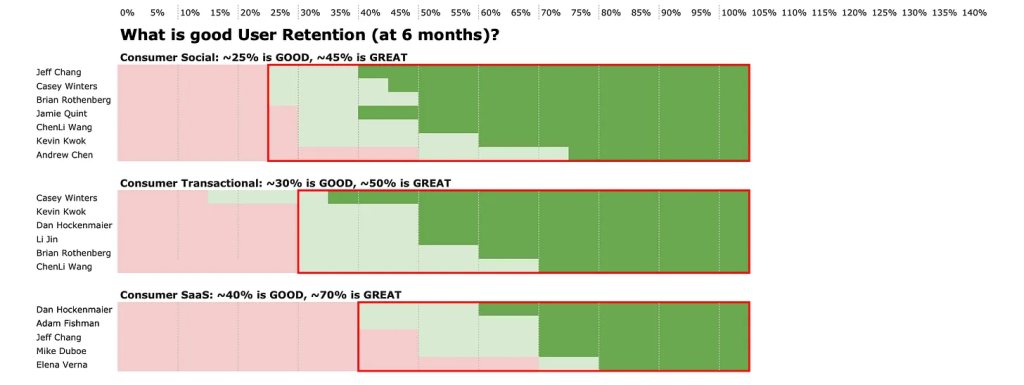
So, as you can see Consumer Social and Transactional are the B2C service categories that experience the highest churn. Quoting the newsletter, here are the three categories and the thresholds they propose:
Consumer social: ~25% is GOOD, ~45% is GREAT
This includes companies such as Snapchat, Twitter, and Instagram that are free to use and are generally supported by advertising. The denominator in this category is registered users.
Expert and investor recommendations
- Jeff Chang: Over 25% is GOOD, over 40% is GREAT
- Casey Winters: Over 25% is GOOD, over 45% is GREAT
- Brian Rothenberg: Over 25% is GOOD, over 50% is GREAT
- Jamie Quint: Over 30% is GOOD, over 40% is GREAT
- ChenLi Wang: Over 30% is GOOD, over 50% is GREAT
- Julie Zhou: Over 30% is GOOD, over 60% is GREAT
- Kevin Kwok: Over 30% is GOOD, over 60% is GREAT
- Andrew Chen: Over 50% is GOOD, over 75% is GREAT
Public companies
- Facebook: 60%-70% 6-month user retention
- Instagram: 50%-60% 6-month user retention
- Snapchat: 33% 3-month user retention, 30% 24-month (source, source)
- Twitter: 31% 3-month user retention, 22% 24-month (source, source)
Consumer transactional: ~30% is GOOD, ~50% is GREAT
This includes companies such as Airbnb, Lyft, and TurboTax that are generally supported by one-off purchases. The denominator in this category is users who have made at least one transaction.
Expert and investor recommendations
- Casey Winters: Over 15% is GOOD, over 35% is GREAT
- Kevin Kwok: Over 30% is GOOD, over 50% is GREAT
- Dan Hockenmaier: Over 30% is GOOD, over 50% is GREAT
- Li Jin: Over 30% is GOOD, over 50% is GREAT
- Brian Rothenberg: Over 30% is GOOD, over 60% is GREAT
- ChenLi Wang: Over 30% is GOOD, over 70% is GREAT
Public companies
Consumer SaaS: ~40% is GOOD, ~70% is GREAT
This includes companies such as Netflix, Spotify, and Hulu that sell a monthly/yearly subscription to consumers. The denominator in this category is users who have started a paid subscription.
Expert and investor recommendations
- Dan Hockenmaier: Over 40% is GOOD, over 60% is GREAT
- Adam Fishman: Over 40% is GOOD, over 70% is GREAT
- Jeff Chang: Over 50% is GOOD, over 70% is GREAT
- Mike Duboe: Over 50% is GOOD, over 70% is GREAT
- Elena Verna: Over 70% is GOOD, over 80% is GREAT
Public companies:
Amazon Prime: 93% 12-month customer retention (source)
Dropbox: ~80% 12-month customer retention
Spotify: 72% 6-month customer retention (source, source)
Netflix: 66% 12-month customer retention (source)
Hulu: 53% 12-month customer retention (source)