
ISO vs NSO Options: Key Differences, Tax Impact, and How to Choose

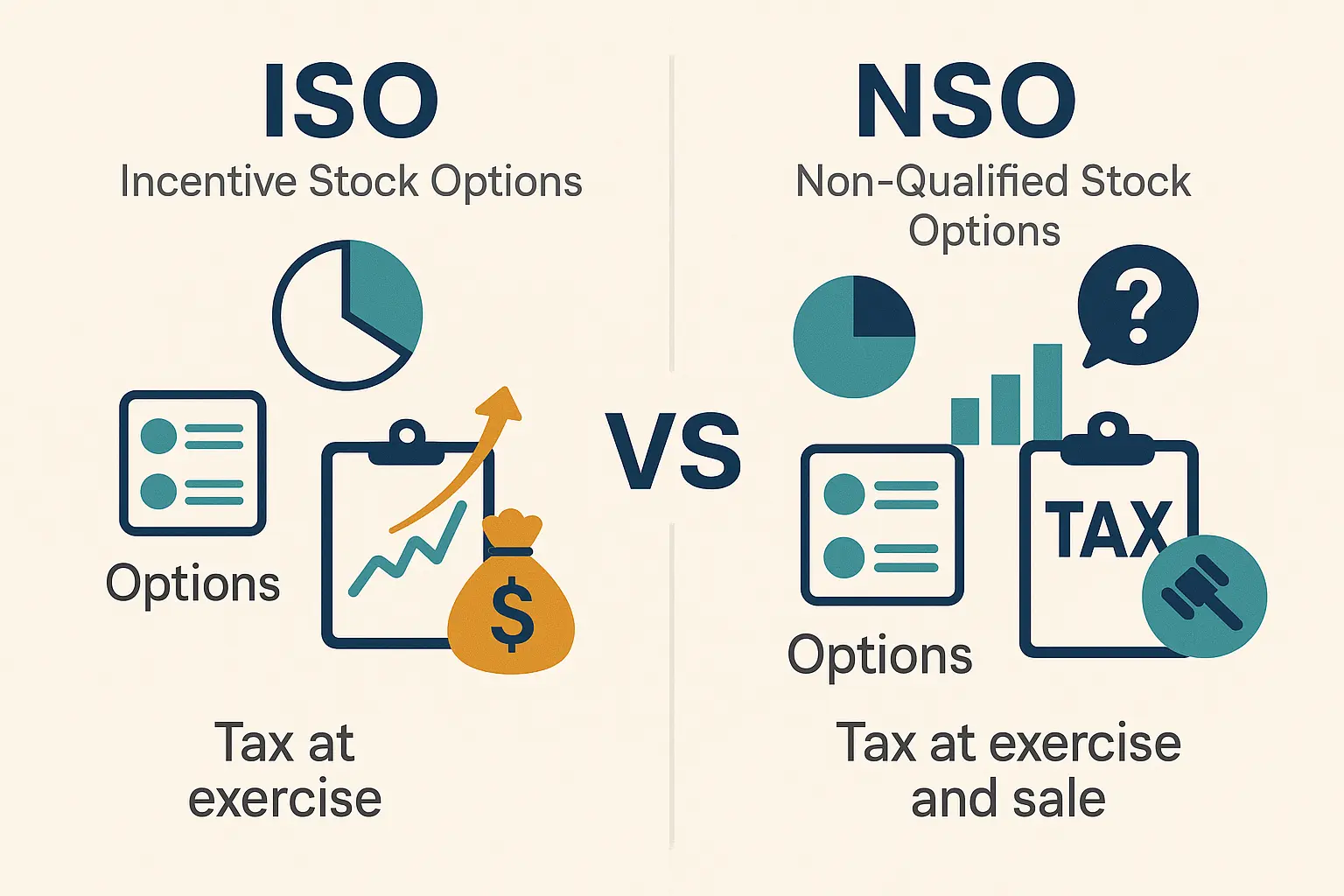
Stock options—especially Incentive Stock Options (ISOs) and Non-Qualified Stock Options (NSOs)—can be a big part of your compensation if you work at a startup or tech company. While both types let you buy company shares at a set price, the rules around taxes, eligibility, and what happens when you exercise or sell them can be surprisingly different.
Here’s why it matters: According to data from the National Center for Employee Ownership, over 9 million U.S. employees hold stock options or similar equity, but many miss out on potential gains or face unexpected tax bills simply because they don’t understand the basics. A single decision—like when or how to exercise—can mean thousands of dollars in extra taxes, or none at all.
If you’ve ever been offered ISOs or NSOs and felt unsure about the fine print, you’re not alone. This guide breaks down the differences, explains the tax impact, and gives you practical steps on deciding which type is right for you—without overwhelming legal or financial jargon.
Quick Overview: What Are ISOs and NSOs?
Incentive Stock Options (ISOs) Explained
Incentive Stock Options, or ISOs, are a special type of stock option found mostly at startups and tech companies. They’re only available to employees, and if you follow certain holding rules, the profit you make may qualify for lower long-term capital gains tax rates rather than regular income tax. ISOs come with some strict rules—there are limits to how much you can receive in a year and when and how you can exercise your options without triggering extra tax complications.
Non-Qualified Stock Options (NSOs) Explained
Non-Qualified Stock Options, or NSOs, are far more flexible. Companies can grant them to employees, consultants, advisors, or even board members. When you exercise NSOs, any potential gains are typically taxed as regular income immediately, instead of possibly qualifying for the lower capital gains rate. There aren’t as many restrictions on NSOs, making them a popular default choice for a broader set of recipients.
Understanding these two types of stock options is the first piece of the puzzle—next, let’s see how they work in real workplace scenarios and what you might expect day to day if you’re granted either type.
How ISO and NSO Options Work in Practice
Eligibility and Who Gets Them
Companies reserve ISOs primarily for employees. The IRS sets these rules: only direct employees of a corporation (not contractors or board members) may receive ISOs. In contrast, NSOs have fewer restrictions, making them accessible to employees, independent contractors, consultants, and directors. This flexibility allows startups to reward a broader group of contributors with NSOs, not just those on the payroll.
Vesting and Exercise Mechanisms
Both ISO and NSO grants come with a vesting schedule—often four years with a one-year cliff. With vesting, you earn the right to exercise more options as you continue working for the company. After meeting the vesting requirement (such as the first anniversary), you may begin exercising your options to buy shares at the strike price.
Exercising options means paying the strike price, set at the grant date, to buy shares. For both ISOs and NSOs, the process is similar: after vesting, you decide when to pay this price and acquire company stock. However, post-exercise tax implications depend on whether your grant is an ISO or NSO, which can heavily influence the timing and strategy for exercising.
It’s also important to note the exercise window—typically 90 days after leaving the company for ISOs, while NSOs may sometimes offer more flexibility. Ignoring the cutoff can mean losing your right to buy the shares altogether.
This difference in eligibility and underlying mechanics sets the stage for the real divergence: what happens at tax time. Next, we’ll walk through how taxation kicks in at the point you exercise, and later when you sell the shares, so you can see how your choice affects your wallet.
Comparing Tax Treatments: ISO vs NSO Options
What Happens When You Exercise
Exercising an ISO doesn’t trigger regular income tax as long as you hold onto the shares after purchasing them. However, the “bargain element”—the difference between the exercise price and market value—counts toward the Alternative Minimum Tax (AMT). For NSOs, exercising instantly creates taxable income for the year: the bargain element is taxed as ordinary income and is subject to Medicare and Social Security taxes.
Sale Events: How Gains Are Taxed
ISOs offer favorable capital gains treatment, but only if you hold the shares for at least one year after exercising and two years after the option grant date. Sell too soon, and the gain is treated as ordinary income. With NSOs, any post-exercise appreciation (the value increase after you bought the shares) is taxed as a capital gain if you hold the stock after exercising—otherwise, the gain at exercise time remains ordinary income.
Alternative Minimum Tax and ISOs
The big caveat with ISOs is the AMT. If your ISO exercise pushes your bargain element high enough, you might owe AMT—a surprise bill at tax time. Carefully calculating your potential AMT exposure before exercising ISOs can help you avoid headaches later.
Reporting Requirements
For ISOs, if you sell the shares in the same year you exercised, your company will report this activity on Form 3921, and you must flag it on your tax return—especially if the sale is a disqualifying disposition. For NSOs, the income is reported on your W-2 (if you’re an employee), making the process more straightforward but potentially increasing your tax bill in the exercise year.
Understanding these subtle but impactful tax rules is crucial—next, we’ll weigh the practical advantages and drawbacks of each type of option from both the employee’s and company’s perspective.
Pros and Cons for Employees and Companies
Pros and Cons of Incentive Stock Options (ISOs)
ISOs often appeal to employees because of their favorable tax treatment. If specific holding periods are met, gains may qualify for long-term capital gains tax instead of higher ordinary income rates. This can translate into meaningful savings when selling exercised shares. Additionally, ISOs are only available to employees, serving as a targeted incentive for long-term retention and alignment with the company’s goals.
But ISOs have their drawbacks. The biggest pitfall for many is the Alternative Minimum Tax (AMT). Exercising a significant amount of ISOs in a year can trigger a higher tax bill, even if shares aren’t sold and cash hasn’t been realized. On the employer side, ISOs are more restrictive—they can only be granted to employees and come with strict legal requirements. Companies also don’t get a tax deduction unless there’s a disqualifying sale by the employee, making ISOs less attractive from a corporate tax planning perspective.
Pros and Cons of Non-Qualified Stock Options (NSOs)
NSOs are much more flexible. Companies can grant them to employees, contractors, and even board members, creating more possibilities for talent acquisition and retention. From a company’s standpoint, NSOs provide an immediate tax deduction at exercise—an incentive for startups and established businesses alike.
For employees, the tradeoff is higher taxes: gains at exercise are taxed as ordinary income, regardless of holding period. This often results in a larger upfront tax bill compared to ISOs. However, NSOs come without AMT complexity, making them easier to plan for, especially for those who don’t want to risk a surprise tax hit in April. The additional flexibility and simpler rules help both the issuer and recipient sidestep some compliance hassles present with ISOs.
Weighing these trade-offs can feel overwhelming, but understanding how they play out in real scenarios can make your next step clearer and help you choose the right path forward.
ISO vs NSO: Factors to Consider When Choosing
What to Ask Your Company (or Yourself)
Before accepting or exercising any stock options, clarify a few essentials. Start with: Are you being offered ISOs, NSOs, or a mix? Who is eligible for each type—and do your options switch to NSOs if you leave? Don’t forget to get the details on vesting schedules, expiration timelines, and early exercise opportunities. If you plan to stay long-term, ISOs might offer tax perks. If you want more flexibility or expect to exercise options after leaving, NSOs could be more practical.
Also, ask about how your company values shares for tax purposes and if there’s recent or upcoming fundraising that could impact your strike price. Knowing these details ahead of time can prevent surprises down the line.
Making a Decision Based on Tax and Lifestyle
Your personal tax situation plays a major role in deciding between ISOs and NSOs. ISOs may create a hefty Alternative Minimum Tax (AMT) bill, especially if your company’s stock skyrockets after exercise but before you sell. On the other hand, NSOs trigger taxes at exercise regardless of whether you sell the shares, so timing and cash flow really matter.
Think about your risk tolerance and financial goals. Do you want to hold for long-term capital gains—even if it means navigating AMT? Or would you rather lock in value and pay taxes now? How comfortable are you with illiquidity if there’s no public market for your company’s stock? There isn’t a one-size-fits-all answer—matching your choices to your lifestyle and future plans is key.
Now that you know what questions to ask and how your choices link with your personal circumstances, let’s look at some real-world scenarios and common questions that come up as you navigate your stock option journey.
Thank you for reading EasyVC’s blog!
Are you looking for investors for your startup?
Try EasyVC for free and automate your investor outreach through portfolio founders!
Common Scenarios and FAQs on ISO vs NSO Options
Switching Between ISO and NSO – Is It Possible?
In most cases, your option type is determined when your company grants the award. Employers decide whether you receive ISOs or NSOs according to your role, company policy, and IRS rules. For example, ISOs are usually only for employees, not advisors or contractors. If you’re hoping to swap ISOs for NSOs or vice versa after your grant, that’s almost never possible except in special cases. The company might convert ISOs to NSOs if you lose eligibility (for example, taking a contractor role), but not the other way around.
Some startups will reprice or reissue options during funding rounds or company reorganizations, but each situation is unique and often out of your direct control. If you have a pending career change or think your status could shift, ask about how your options could change in advance.
What Happens If You Leave Your Job?
Leaving your company starts the clock on a critical deadline. With ISOs, you typically have 90 days from your last day to exercise vested options. After that window, unexercised ISOs usually convert to NSOs, which means a different tax treatment and potentially a higher tax bill if you exercise later.
For NSOs, there may be a longer exercise window, sometimes up to several years depending on the company’s plan, but you lose the favorable tax treatment ISOs offer. If you leave for a new job, get laid off, or retire, review your option grant agreement and talk to your HR or equity administrator right away so you don’t miss important deadlines or trigger unintended taxes.
The circle of decisions around ISOs and NSOs keeps spinning, especially if your career, company status, or tax rates shift. To steer your decision with confidence, it helps to know what questions to ask—both of yourself and your employer—as you line up your next moves.