
Fundraising tips: How we raised $4M as first-time startup founders


This is Dani and Begoña, we raised $4M for our previous startup from Business Angels, groups and Venture Capitals. And now we’re helping founders with EasyVC by automating investor research and getting warm intros through portfolio founders.
We recently spoke with a founder going through a very stressful time with their startup. They had been trying to raise funding for eight months and were now running dangerously low on runway.
This is not an uncommon event in the current market. We have all seen that we are not in 2021 anymore, with 2024 being one of the toughest years, with 966 startups shutting down, compared to 769 in 2023, according to Carta.
Don’t get me wrong, fundraising is all about presenting yourself as the exception to the norm. Regardless of what happens to the market, startups still raise funds, and VCs still deploy capital.
However, if you are having a tough time getting investors onboard, it is useful to go back to basics and remember Adam Draper’s good old saying “Be the Cockroach’’.
For you as a founder, this means that your brain will be operating in two modes simultaeously, the survivor cockroach mode, and the visionairy unicorn mode. You’ll pitch your company to investors as the “inevitable next big thing”, but also you’ll be thinking of strategies for how to make payroll this month. Don’t worry, you’re not the only one in this situation.
This also means that you’re experiencing a massive rollercoaster of emotions where you’ll get an email from an investor saying they’re excited about your round, and later that day, realize that you’ll have to start firing some people if you don’t land an investment ticket soon.
If you’re getting short of runway, here’s the strategy we followed at our previous company to keep things running. Be decisive, don’t wait another month to start doing this.
Cockroach mode:
First, we are going to talk about what you have to do with the first half of your brain. This will keep your company alive, which in a tough market, is already a competitive advantage.
Find alternative sources of cashflow:
You’ve already thought about this, but think again if there are any other sources of cash that you can generate like upselling existing clients, try bigger projects including consultancy/advisory, whatever you can activate, but the most important thing is that you can activate it within a reasonable amount of effort and time.
In our previous startup, we remember some periods where we were getting short on runway and some VCs in our cap table, following the startup-guru common advice, pushed us towards starting B2B in a company where all our systems and infrastructure in place was set up for B2C.
As rookie founders at that moment, we followed the advice and started speaking with big corporates. After months of internal back and forth, we found ourselves drowned in 10-person meetings presenting our B2C product with no real SLAs or infrastructure, to 10 different departments of corporations that constantly kicked the can forward.
Results? Three months of wasted time in meetings, no cash flow generated, and an even tighter runway.
So again, think of alternative ways of generating cash for the company that can be implemented fast, and don’t let others dictate what that thing is. People outside of the founding team sometimes can provide fresh ideas, but they can also be terrible ideas. Accept feedback knowing that you and your team are the only people with real access to all variables and data.
Tough conversation with your existing shareholders:
Yes, everyone was super excited when they took the leap for you and you don’t want to kill the vibes with your investors, but right now it’s either the vibes, or your company.
Set up calls with all your shareholders and have the tough conversation. Tell them they need to pitch in and contribute to the existing round.
At this stage of runway, external investors will heavily factor in the commitment of existing shareholders, and your current investors know (or should know) that.
Don’t walk into that meeting with a tail-between-your-legs attitude. Own up to what could have been better and take responsibility like any founder should. But remember—when your shareholder joined your cap table, your company became a boat with more people aboard that need to help bail if the boat starts sinking in water.
Crawl your way up the funding ladder with small checks:
While you’re riding the bull of making shareholders pitch in and you keep on getting meetings with potential lead investors, put 60% of your fundraising efforts on smaller but quicker checks. Go for business angels that are a bit warm in the round, offer them “early-bird” discounted terms in the round, or create new business angels from people of your network! Most business angels invest once in something they are excited about, make yourself their first investment. Increase your runway with small checks so you can keep fundraising from the big ones. Here’s a visual example of what your strategy would look like for a target valuation of $10M:
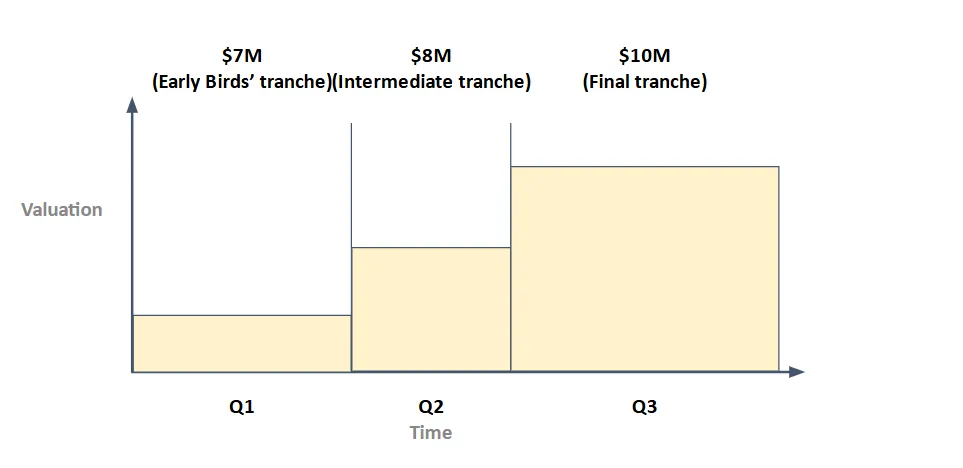
This is a strategy I’ve used through several rough times, and a strategy that
Robin Guo @ a16z recently talked about.
Unicorn mode
Keeping your company alive is necessary, but not the main goal. You didn’t build a vision to disrupt the market to stay alive-by-default for another 4 years.
No one said that building a startup was easy… So on top of everything we said before, now we are going to talk about your second half of the brain, the one you’ll use to take your company to the next level.
Here’s another important metric you need to remember: 0.1% of startups generate 97% of all exit profits (Floodgate). That’s what’s called “The Power Law”, the law present in every successful fundraise.
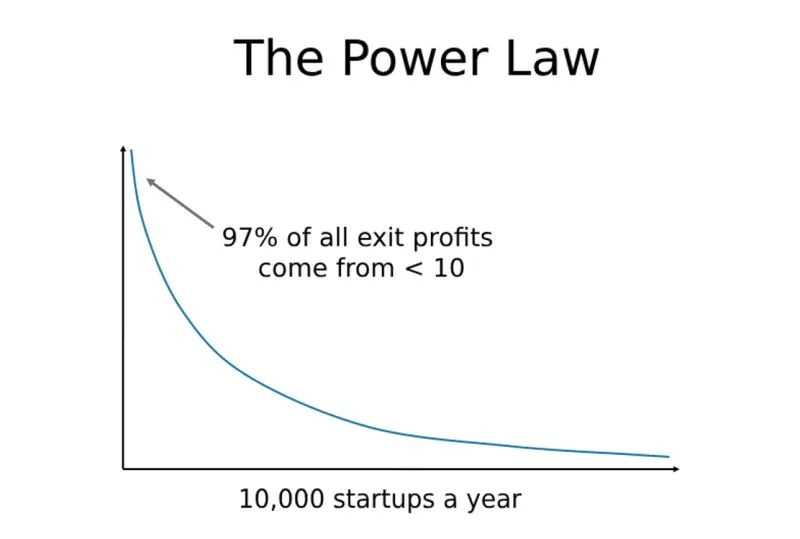
The Power Law indicates that in a typical scenario, out of 100 startups a standard investor backs, only 2-4 will bring returns that multiply the entire fund. The outcome of the remaining 97 investments essentially becomes way less relevant than the overwhelming impact of The Power Law. Same happens with successful artists and music labels, with movies in Hollywood or the video game investments.
As a founder, your mission is to craft a narrative that convinces investors that your company is poised to be one of those rare success stories that can return their entire fund many times over.
This evokes two thoughts:
First: Focus on the size of the outcome, if successful, rather than the probability of success. The investor is going to determine your probability of success without asking you about it anyways…. Based on your team, the space, and many factors that are hard to change. So remember, your job is to focus on the size of the outcome.
Second: The only thing that can drive someone to believe that an investment of $1M is going to turn into more than $100M can’t be the facts. Therefore, emotions play a big role. Anyone who’s ever attempted to change an opinion using just facts knows that emotions, not facts, drive many decisions. Even more when you don’t have all the information. And guess what – investors are human too. Facts in your story only matter insomuch as they generate an emotion that leads to an investment decision (needless to say you should never come with made-up “facts”…!).
Top early-stage investors understand that your ability to evoke emotions amplifies your impact. Therefore:
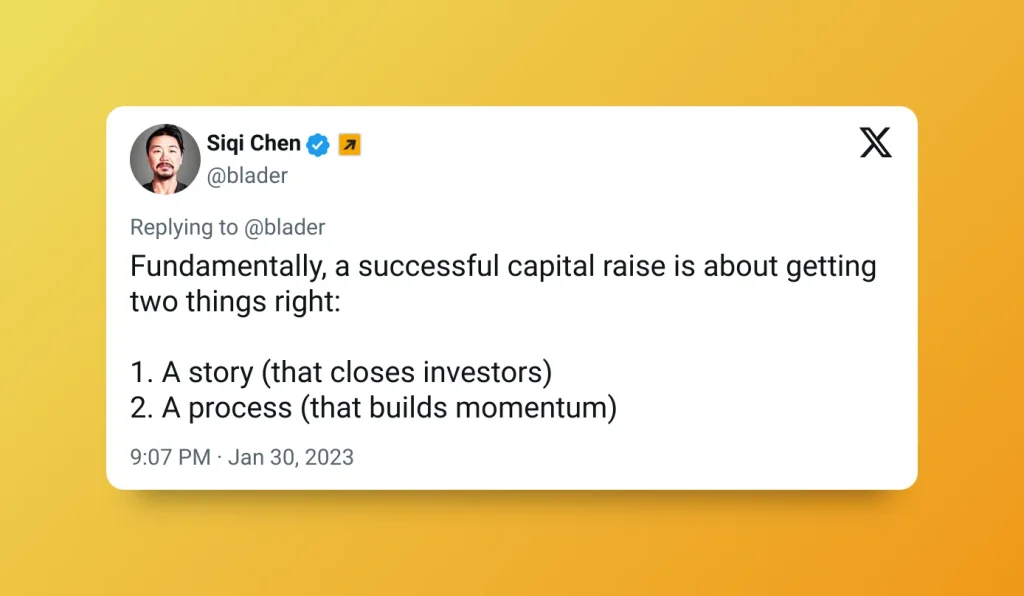
When you think about your story, think of how your company fits in the Power Law. But what about the process?
Put the other 40% of your efforts into the big investors:
The fundraising process is a whole topic itself, so we will talk about it in more detail in the next post, but some tips are:
Your story will help closing the investors, but this story has to be backed by a very important aspect of your round; sense of urgency.
To build a sense of urgency, you need to create density of meetings. The best way I’ve found is by reaching out to founders who have raised capital from the investors you’re targeting (yes, even if you don’t know them) and asking for warm intros. You’ll be surprised how many founders will be keen to help other founders, even if they don’t know you.
The more ongoing conversations you have, the more leverage you have to push the others forward in their Due Diligence.
If you’ve read up to this point, you’ll see that raising with short runway is probably the toughest thing you’re going to go through in your career. You’ll find yourself in a frenzy of emotions where you’ll be riding two completely different beasts.
Take a day to process this and laser-focus on lifting your company up again.