
Understanding Product Market Fit According to Sequoia


Finding product-market fit is the holy grail for every early-stage startup. It’s the moment when your product truly resonates with your target audience, and demand starts to snowball. But how do you achieve this elusive state? Sequoia Capital, a giant in the venture capital world, provides a robust framework to help startups navigate this crucial phase. In this guide, we’ll dive deep into the Sequoia product market fit framework, breaking it down to help you understand how to apply it to your startup.
What is Product Market Fit?
Sequoia’s product market fit is a concept developed by Sequoia Capital, emphasizing the importance of aligning your product with market needs. This framework categorizes product-market fit into three distinct archetypes: Hair on Fire, Hard Fact, and Future Vision. Understanding these archetypes can help you determine where your product stands and what steps you need to take to achieve product-market fit.
How Long Does It Take?
It normally takes more than two years to start feeling product-market fit. Proof of this is perfectly captured in Lenny Rachitsky’s visualization. The data shows that while some startups had a unique market insight/secret that got them there fast, most (including today’s industry leaders) went through numerous trials over several quarters before gaining solid growth and momentum. This chart doesn’t account for examples like OpenAI, which is often viewed as an overnight success, but it actually took 7 years.
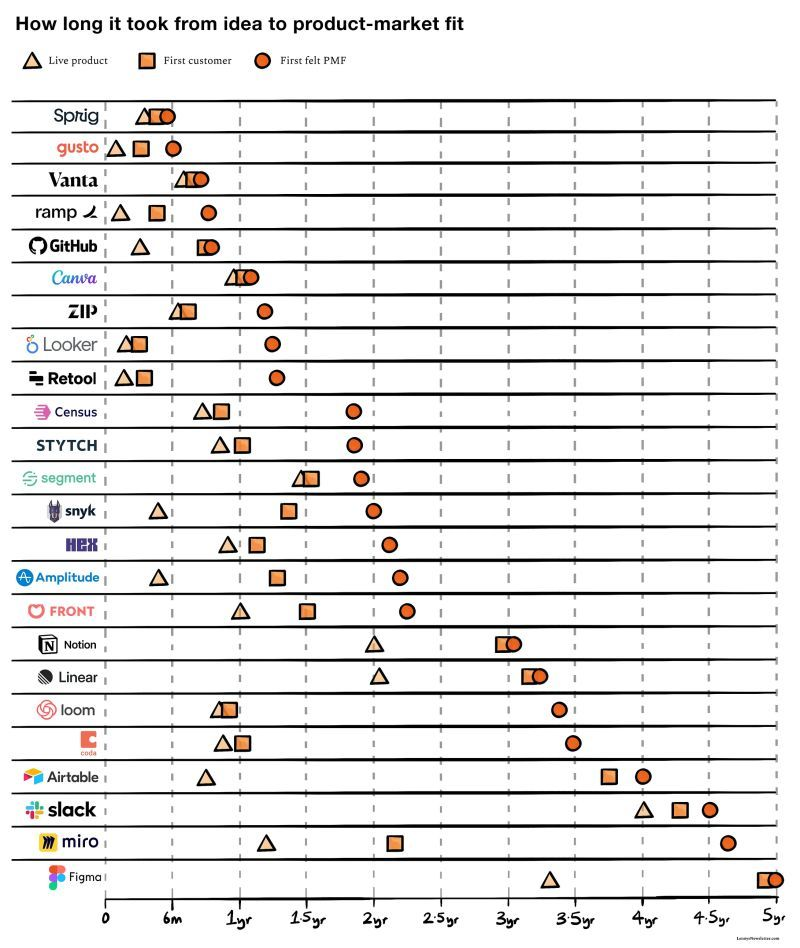
Value gets created compounding execution for years and years; It never gets easier. Keep this also in mind when fundraising. Show this table to investors asking for 30% growth MoM + low CAC + whatever they came up with, at a pre-seed round.
Give yourself time to sort this out AND do not delegate it. You need to be on the front line for this visionary work.
The Three Archetypes of Product-Market Fit
1. Hair on Fire
The “Hair on Fire” archetype addresses problems that are urgent and critical for your customers. These are the issues that keep them up at night, and they’re actively searching for solutions. However, this urgency often means a crowded market with numerous competitors.
To stand out, your solution must be not just better, but different. You need to offer a unique, best-in-class experience that sets you apart from the competition. For example, if you’re entering a market with established players, consider what unique features or benefits your product can offer that others can’t.
2. Hard Fact
In the “Hard Fact” archetype, you tackle problems that customers have accepted as a part of life. They’ve resigned themselves to dealing with these issues because they see no alternative. Your task is to show them that change is possible and beneficial.
The challenge here is overcoming inertia. Customers are used to the status quo, and convincing them to adopt a new solution requires a novel approach. Your product must be compelling enough to make them rethink their habits and embrace a new way of doing things.
3. Future Vision
The “Future Vision” archetype is all about visionary innovation. Your product introduces a new reality that seems like science fiction to customers. They might not even realize they need it until they see it.
This path is often long and requires building a new ecosystem around your product. Think of the iPhone and its App Store or Tesla’s electric cars and self-driving technology. Your challenge is to make this new paradigm irresistible, showing customers the incredible possibilities your product opens up.
How to Apply Sequoia’s Product Market Fit to Your Startup
1. Identify Your Archetype
The first step is to identify which archetype best fits your product. Are you solving an urgent problem (Hair on Fire), addressing a widely accepted issue (Hard Fact), or introducing a visionary innovation (Future Vision)? Understanding this will guide your strategy and help you focus on the right areas.
2. Understand Your Customer
Next, deeply understand your target customers and their relationship with the problem you’re solving. Conduct surveys, interviews, and market research to gather insights. This understanding will inform your product development and marketing strategies about investor connections.
3. Differentiate Your Product
Regardless of your archetype, differentiation is key. Your product must stand out in some way, whether through unique features, superior performance, or an innovative approach. Highlight these differences in your marketing efforts to attract and retain customers by using incubators.
4. Test and Iterate
Achieving product-market fit is an ongoing process. Continuously test your product with real users, gather feedback, and iterate. This cycle of testing and improvement will help you refine your product and better meet market needs. Consider studying best seed pitch decks to gather ideas for refinement.
Conclusion
Understanding and achieving Sequoia product market fit is crucial for the success of your startup. By identifying your archetype, understanding your customers, differentiating your product, and continuously iterating, you can navigate the path to product-market fit and set your startup on the road to success. To further explore aspects of fitting your innovations to the market, consider the examples of product-led growth.