
40 (now 61) Pre Seed & Seed Pitch Deck Examples That Raised Over $460 Million

Have you ever wondered what the secret sauce is behind the most successful startups? You might be surprised to learn that a simple presentation—known as a pitch deck—can make all the difference. In this article, we’re going to unveil 69 pre-seed & seed pitch deck examples that helped startups raise over $460 million. But that’s not all; we’ll also share key insights you can use to create your own winning pitch deck. Ready to discover what sets these decks apart?
What Is a Pitch Deck and Why Is It Important?
A pitch deck is a brief presentation that gives potential investors an overview of your business. It covers essential aspects like your product or service, business model, market opportunity, team, and financial projections. Think of it as your startup’s storybook, designed to persuade investors to support your vision.
But why is a pitch deck so important? In the competitive world of startups, you often have just one chance to impress potential investors. Your pitch deck is your opportunity to make a strong first impression and stand out from the crowd. It’s not just about showcasing your idea; it’s about conveying your passion, demonstrating your competence, and convincing investors that your startup is worth their time and money.
Key Elements of a Successful Pitch Deck
While every pitch deck is unique, successful ones often share common elements:
Solid Team Presentation
Introduce the key members of your team and their qualifications. Pre-seed and Seed investors bet on the team’s expertise and experience. Think about it, if there is no data of the business yet, the only constant of the business is the team. Make this slide shine.
Clear Value Proposition
Your pitch deck should clearly state what problem your product or service solves and why it’s valuable. Investors need to understand quickly how your startup improves people’s lives or addresses a gap in the market.
Understanding of the Market
Demonstrate that you know your target market inside and out. This includes the size of the market, growth trends, and customer demographics. Showing that there is a substantial and growing demand for your solution is crucial. Learn more about mastering key activities in validating product-market fit to understand your market better.
Strong Business Model
Explain how your startup will make money. Investors want to see a viable path to profitability. Outline your revenue streams, pricing strategy, and any plans for scaling the business.
Competitive Advantage
Highlight what sets you apart from competitors. What is your unique selling proposition? Do you have proprietary technology, exclusive partnerships, or a unique approach that others can’t easily replicate?
Engaging Storytelling
Use your pitch deck to tell a compelling story that resonates with investors. People connect with stories, so weave a narrative that illustrates your journey, challenges, and vision for the future. Product led growth strategies can provide inspiration for compelling storytelling.
Realistic Financial Projections
Provide clear and realistic financial forecasts. Include revenue projections, profit margins, and funding requirements. Be prepared to explain your assumptions and how you plan to achieve these numbers. Utilize a financial projection template to streamline your projections.
Thank you for reading EasyVC’s blog!
Are you looking for investors for your startup?
Try EasyVC for free and automate your investor outreach through portolio founders!
Lessons from 61 Successful Pitch Decks
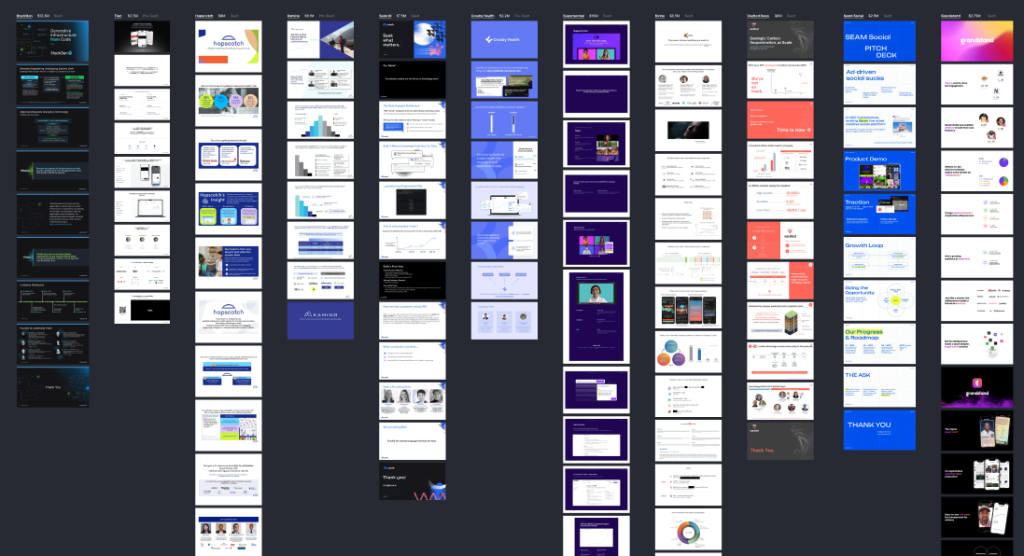
We’ve compiled a resource featuring 40 (now + 21) startup pitch decks that collectively raised over $460 million. This resource contains current known startups such as Artisan or Boardy. You can explore them here: 61 startup pitch decks that raised over $460M. Let’s dive into some key lessons these examples teach us.
Lesson 1: Simplicity Is Powerful
Many successful pitch decks are simple and to the point. They use clear language and avoid jargon. For example, Airbnb’s pitch deck conveys complex ideas in a straightforward manner, making it easy for investors to grasp the concept quickly.
Lesson 2: Visuals Matter
Engaging visuals can make complex information easier to understand. Charts, graphs, and images help convey your message quickly. Dropbox’s pitch deck, for instance, uses visuals effectively to demonstrate how their product works.
Lesson 3: Know Your Numbers
Solid financial projections and metrics build credibility. Investors are numbers-driven, so provide realistic data. Square’s pitch deck includes detailed financials and key performance indicators that instill confidence. Master retention rate formulas to support your data.
Lesson 4: Showcase Your Team
Investors back people as much as ideas. Highlight your team’s experience and expertise. The pitch deck from Snapchat emphasizes the founders’ backgrounds and why they’re the right people to execute the vision.
Lesson 5: A Clear Ask
Be specific about how much funding you need and how you will use it. Transparency about your funding requirements and allocation shows that you have a well-thought-out plan.
How to Use These Examples to Create Your Own Pitch Deck
Studying successful pitch decks can inspire you, but it’s important to tailor your deck to your own startup. Here’s how you can use these examples effectively.
Understand the Structure
Notice how these decks are organized. They usually follow a logical flow:
1. Title Slide: Startup name and tagline.
2. Problem: What issue are you addressing?
3. Solution: How does your product or service solve the problem?
4. Market Size: How big is the opportunity?
5. Product: Showcase your product with screenshots or demos.
6. Business Model: How will you make money?
7. Marketing and Growth Strategy: How will you acquire customers?
8. Team: Who are the key players?
9. Financials: Revenue projections and funding requirements.
10. The Ask: How much investment are you seeking?
Adapt the Content
Use the content as a guide but make sure your deck reflects your unique offering and company culture. Authenticity is key. Investors can tell when something doesn’t align with your brand.
Focus on Clarity
Ensure that your message is clear and easy to understand. Avoid cluttering slides with too much information. Each slide should convey one main idea.
Personalize Your Story
Share your journey and what inspired you to launch your startup. Personal stories can make your pitch more memorable. Learn from our comprehensive guide on scalable startup entrepreneurship.
Get Feedback
Share your draft with mentors, peers, or industry experts. Constructive feedback can help you identify areas for improvement.
Tips for Designing an Engaging Pitch Deck
Creating a pitch deck isn’t just about the content; design plays a crucial role in capturing attention.
Use Professional Templates
Consider using professionally designed templates to ensure your deck looks polished.
Consistent Branding
Use consistent colors, fonts, and styles that align with your brand identity.
High-Quality Images
Incorporate high-resolution images and graphics to enhance visual appeal.
Readable Fonts
Choose fonts that are easy to read, even from a distance, in case you’re presenting on a screen.
Limit Text
Keep text concise. Use bullet points and short sentences.
11 Common Mistakes to Avoid in a Pitch Deck
The truth is, VCs take just minutes or even seconds to review your pitch deck and decide whether to keep reading. If it doesn’t grab their attention quickly, chances are they’ll move on. And once they do, they rarely come back.
The #1 reason most decks fail? They don’t do one thing: create curiosity. Investors should finish your pitch deck wanting a meeting with you, not feeling like they already know the whole story.
Every slide is an opportunity to get to know the founder. Your expertise, your intuition, and your vision are key to making them want to keep reading. Show them you’ve lived the problem. Show them you’re the one to solve it.
Here are the 10 most common pitch deck mistakes that quietly kill investor interest before Slide 3.
1. When the “Problem” Isn’t Actually a Problem
Mistake: Presenting a generic, abstract, or minor inconvenience as “the problem.”
Why it fails: Investors have only seconds to decide if they care. If the problem isn’t real, top-of-mind, and painful, it’s forgettable. No urgency means no interest.
Fix: Use the Problem Severity Scale to calibrate your framing:
- Minor inconvenience
- Regular frustration
- Time/money loss
- Critical business impact
- Existential threat
Frame the problem as an expanding opportunity and back it up with real data to create urgency.
Too generic: “The healthcare system is broken.”
Engaging: “68% of healthcare providers are losing $47B per year due to [problem].”
2. Pitching Market Size, Not Market Entry
Mistake: Throwing up a huge TAM slide and calling it a day.
Why it fails: VCs see a lot of pitch decks every day. If they’re industry-specific investors, many of them might even know the market better than you.
The truth is, investors don’t fund theoretical market size, they fund your ability to actually enter and win. A big market is meaningless if you can’t break into it.
Yes, the market opportunity has to be big enough (not vague) and growing. And yes, you need to show ambition. But what investors really care about is: What piece of the pie can you realistically capture early on?
The second lesson regarding this slide is about your secret insight (a.k.a. the ‘key insight’) – the unique angle or truth that sets you apart. What do you know about this market that others haven’t figured out yet?
Fix: Introduce ECA: Early Customer Accessibility:
- How dominant are incumbents in your market?
- How high are the switching costs?
- How often do customers switch to new solutions?
If your answers are “very, very, and rarely,” you’re in a tough spot.
3. Weak Open and Close: The Hourglass Problem
Mistake: Starting with metrics or traction and ending with a generic “ask.”
Why it fails: Investors buy emotionally first and justify rationally later. The issue here is that you’re missing the emotional hook that gets them excited.
Fix: Use the Hourglass Narrative:
- Start with Vision (why this matters and the problem)
- Back it up with Evidence (product, traction, market data)
- End with Vision again (future potential, emotional pull)
Vision is what truly sells. Metrics justify. End with belief. Make the investor feel the future potential. Inspire them to want in.
4. Generic Competition Slides
Mistake: Dropping a 2×2 grid that just says “we’re in the top-right corner.”
Why it fails: It shows no real understanding of the competitive landscape. Investors won’t waste time trying to decipher it.
Fix: Tell a narrative:
- What exists today
- Why it doesn’t work
- What you’re doing differently
- Why now is the right moment
Your competition slide should demonstrate true insight, not just marketing fluff.
Also, highlight your Unique Competitive Advantage. What gives you an edge over the competition?
- Proprietary technology
- Exclusive partnerships
- Unique data sets
- Network effects
- First-mover in a new category
- Superior distribution channels
5. Failing to Showcase the Strengths of the Founding Team
Mistake: Speaking like an outsider and failing to showcase your deep expertise and connection to the problem.
Why it fails: VCs want to back founders with deep, firsthand knowledge of the problem and the industry.
Fix: Use your Team slide to demonstrate your founder-market fit. Show how your experience, insights, and connections prove that you’ve lived the problem and have the skills to win.
Examples of Must Haves:
- 3+ years in the industry
- Deep understanding of customer pain
- Knowledge of existing solutions
Examples of Nice to Haves:
- Industry recognition
- Previous success in the space
- Technical expertise
- Sales experience
Make your bio earn trust:
- Why are you the right person to build this product?
- Have you sold to or built in this market before?
- Do you have a track record of execution?
- Are you a serial entrepreneur?
6. The “Multi-Argument” Slide
Mistake: Trying to make several points on one slide.
Why it fails: Investors skim decks in seconds. If they can’t get the main point at a glance, they move on.
Fix: Focus on one core message per slide. Keep it simple and digestible.
7. Putting an Exit Slide in a Seed Deck
Mistake: Including an “exit strategy” slide too early.
Why it fails: Investors want founders who are building for the long-term, not just planning for a quick exit.
Fix: Focus on the category you’re creating and why now is the right time. Show ambition, not exit timelines.
8. Treating Funding as a Runway Buffer, Not a Milestone Engine
Mistake: Saying “this round gives us 18 months of runway.”
Why it fails: Runway is not a plan. You risk sounding like a money pit.
Fix: Show how this funding will enable specific milestones:
- Ship V2
- Sign 5 design partners
- Prove CAC:LTV loop
- Close first BD hire
9. Underselling the Product
Mistake: No demo, no visuals, no clear story of how it solves the problem.
Why it fails: Without something concrete, interest fades. If you haven’t built anything without funding, why should they believe you’ll succeed with it?
Fix: Make the product real. Show MVPs, demos, usage, or traction.
10. Pitching Like a Consultant
Mistake: Overly polished, abstract slides that feel like a consulting presentation.
Why it fails: Investors want to hear from the founder, not a strategist.
A consultant pitch says:
“We’ve identified a $47B opportunity to disrupt with AI.”A founder pitch says:
“We lived this problem for 4 years. We know exactly why legacy tools fail—and here’s what we’re building instead.”
11. The Truth About Pitch Decks Most Founders Don’t Hear Enough
Your pitch deck isn’t supposed to close the deal or get investors to wire the money. It’s supposed to earn the meeting.
Spark curiosity. Leave them wanting more. Close the meeting.
And remember, no pitch deck is ever truly finished. It will evolve as your company grows, and so will your story.
So stop chasing perfect. Instead, tell a unique story. Make it real and authentic. Make it credible. And above all, make it yours.
Preparing for Your Pitch Presentation
Once your pitch deck is ready, it’s time to prepare for the presentation.
Practice Your Delivery
Rehearse your presentation multiple times. Time yourself to ensure you stay within any time limits.
Anticipate Questions
Think about the questions investors might ask and prepare answers in advance.
Tell a Story
Engage your audience by telling a story rather than just presenting facts. This makes your pitch more relatable.
Be Passionate
Let your enthusiasm for your startup shine through. Passion is contagious and can persuade investors to get on board. Find out how to find investors the right way to pitch your startup effectively and follow a process that lands meetings with them.
Pitch Deck FAQs
How many slides should a pitch deck have?
Most winning pitch decks land in the 10 to 15 slide range. Shorter decks with crisp content keep investors’ attention. If you can tell your story in less than 10, that’s even better. Avoid slide overload—if you can’t remember what’s on slide 17, nobody else will either.
Is it okay to share my deck publicly?
Some founders hide their decks like state secrets; others post them on Twitter. The safe move: keep anything sensitive (like financials or IP) for investor meetings, but don’t be afraid to use a teaser version online or at events. Sharing can lead to valuable feedback—or even unexpected intros.
Final Thoughts
Creating a compelling pitch deck is a critical step in securing funding for your startup. By studying these 61 pre seed & seed pitch deck examples, you can gain valuable insights into what works. Remember, the goal is to communicate your vision effectively and convince investors that your startup is worth their investment. So, start crafting your pitch deck with these lessons in mind, and you’ll be one step closer to turning your entrepreneurial dreams into reality.